Hawaiʻi’s Students Are Not Waiting for the Future of AI — They are Building It
Across the country, schools are struggling with the same question: What should students actually learn about artificial intelligence?
For many parents and educators, AI can feel overwhelming. Headlines often focus on cheating, misinformation, job displacement, or fears that technology will replace human creativity and critical thinking. But in Hawaiʻi, a growing initiative called the Design Intelligence Lab (DIL) is demonstrating a different possibility: AI can become a tool for empathy, creativity, problem-solving, and student empowerment when it is taught through human-centered design.
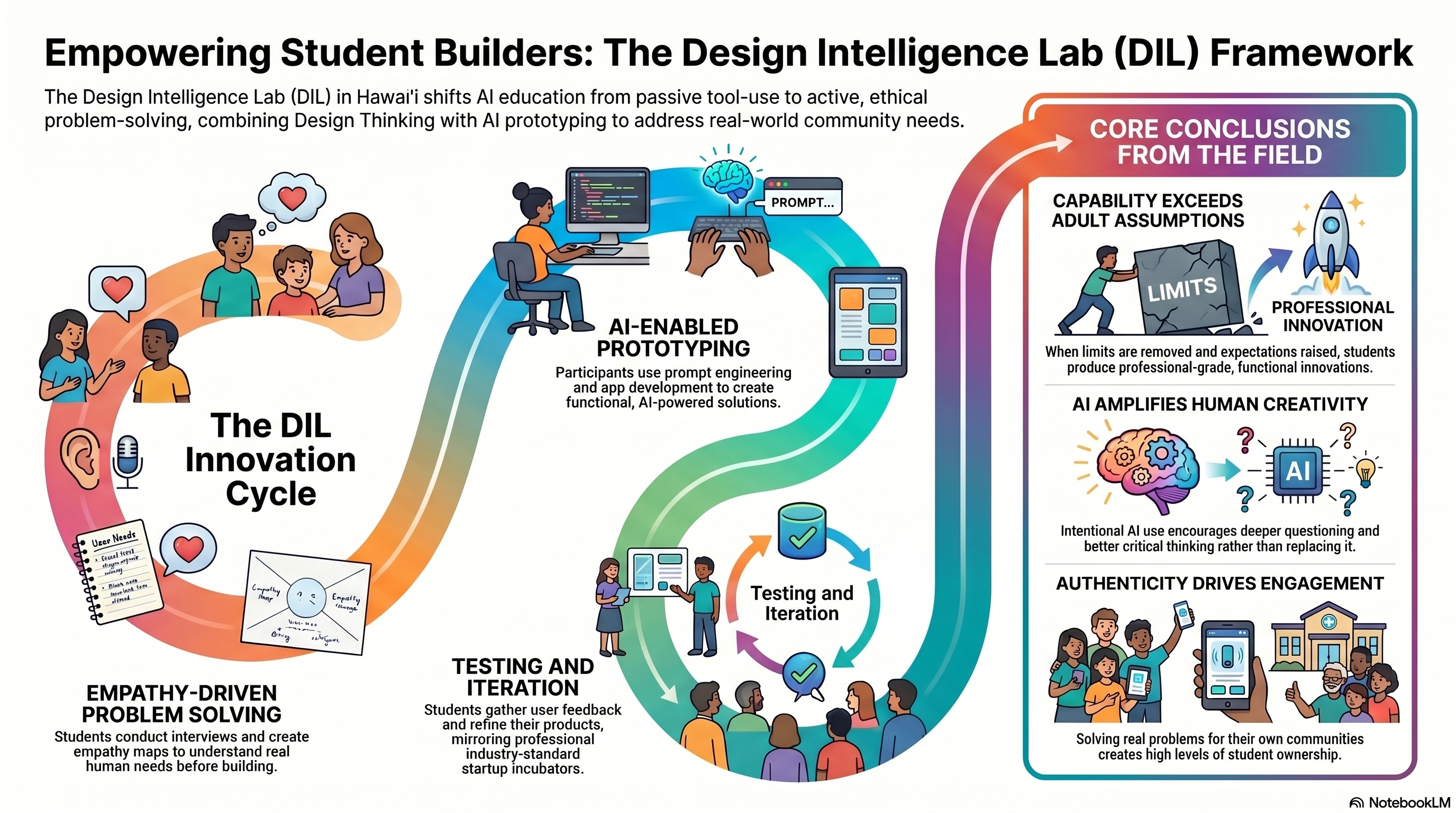
The Design Intelligence Lab is not about teaching students to passively consume AI tools. It is about teaching them to become thoughtful builders of AI by using AI. students who identify real problems in their schools and communities, talk directly with the people affected by those problems, and then use AI to prototype meaningful solutions.
And the results from the 2024 and 2025 cohorts suggest something important:
Young people are far more capable of responsibly using AI than many adults assume.
What Is the Design Intelligence Lab?
The Design Intelligence Lab (DIL) is a Hawaiʻi-based educational initiative that combines:
- Design Thinking
- Artificial Intelligence
- Project-Based Learning
- Human-Centered Problem Solving
- Real-world prototype development
Students are not simply learning “what AI is.” Instead, they are learning how to apply AI tools to solve authentic problems that matter to their peers and communities.
The program teaches students to:
- identify real user needs,
- conduct interviews and empathy mapping,
- define meaningful problems,
- prototype AI-enabled solutions,
- gather user feedback,
- iterate and improve their ideas,
- and communicate their solutions ethically and effectively.
This is a major philosophical shift from traditional technology education.
Instead of asking:
“How do we teach students to use AI tools?”
DIL asks:
“How do we help students use AI responsibly to improve people’s lives?”
That distinction matters.
The 2024 Program: Building Confidence and Breaking Fear
The inaugural 2024 Design Intelligence Lab program brought together approximately 70 students, 12 advisors, and 24 adult stakeholders from schools across Hawaiʻi.
Students participated in workshops focused on:
- Empathy Interviews
- Design Thinking
- Prompt Engineering
- Prototyping
- Storytelling
- AI-assisted Application Development
Importantly, the process started with people — not technology.
Students interviewed real users and created empathy maps to understand frustrations, needs, and experiences before building anything.
This grounded the technology in compassion and human experience.
The Problems Students Chose to Solve
The student teams tackled issues deeply connected to student life and well-being, including:
- Academic support
- Scholarship access
- Financial literacy
- Belonging and social connection
- Mentorship
- Educational planning
Some examples included:
School | Project |
|---|---|
Palisades Elementary | “Ready Set Math Chat Buddy” for math support |
Iao Intermediate | AI financial literacy assistant |
Baldwin High | Scholarship access chatbot |
Hilo High | “Gerald Chatbot” to improve student belonging |
Kalani High | AI counselor and alumni mentorship systems |
These were not hypothetical exercises. Students were solving problems they personally experienced or witnessed in their schools.
A Surprising Outcome: Students Exceeded Expectations
One of the clearest findings from the 2024 report was that adults consistently underestimated what students could accomplish.
The report repeatedly emphasized the importance of:
“Don’t put limits on the students. Raise your expectations.”
Program leaders discovered that when students were given meaningful problems, supportive mentorship, ethical guidance and access to modern AI tools they became highly motivated creators.
Superintendent Keith Hayashi described the program as:
“truly transformative.”
The initiative also sparked broader conversations within Hawaiʻi’s Department of Education around AI policy, safety, and responsible classroom integration.
This is a crucial point for parents and educators:
The DIL program did not ignore concerns about AI.
Instead, it confronted them directly through:
- Transparency
- Ethics
- Mentorship
- Human-centered design
- Structured learning
The 2025 Program: From Ideas to Functional Products
If 2024 proved students could build with AI, the 2025 cohort proved they could do it at a remarkably high level.
The 2025 Design Intelligence Lab Civic Leadership program produced outcomes that resembled early-stage startup incubators more than traditional classroom projects.
Key Findings from 2025
The results were striking:
- 9 out of 12 student teams produced functional or working prototypes.
- Multiple projects underwent real-world testing with students and teachers.
- Several teams gathered quantitative user feedback and engagement metrics.
- Projects across five schools achieved user-interest rates of 84% to 89%
- Students iteratively improved products based on user testing.
This is exactly how modern innovation works in industry and entrepreneurship.
The students were learning:
- Product Design
- Communication
- Software Logic
- Usability
- Collaboration
- Systems Thinking
all while learning how to use AI responsibly.
Student Projects That Solved Real Problems
The projects tackled highly relevant issues for students.
WhereU@AMS — Aliamanu Middle School
The top-ranked project, “WhereU@AMS,” addressed social connection challenges for transient and military-connected students.
Features included:
- activity postings
- interest matching
- inspiration walls
- school transportation tools
But the most impressive part was not the app itself.
It was the validation process:
- ~140 student testers
- over 1,000 app opens
- approximately 70 feedback forms collected
These middle school students were essentially practicing user research, iterative development, and product validation.
Pat Pat Prep
Another Aliamanu Middle School project created a gamified academic planning system for middle school students.
The students noticed something fascinating during testing, that students were highly motivated by competition. So they added a leaderboard feature after receiving user feedback. That single detail captures one of the most powerful aspects of the program. Students were not simply building technology. They were learning to observe human behavior and adapt solutions accordingly.
Why Parents Should Pay Attention
Many parents worry that AI will reduce creativity or critical thinking.
But the DIL model demonstrates the opposite can happen when AI is used intentionally.
The students in this program were not outsourcing thinking to AI.
They were:
- asking better questions,
- engaging in empathy
- analyzing feedback
- solving meaningful problems
- communicating ideas
- testing hypotheses
AI became a tool that amplified creativity rather than replacing it.
The program also reinforced something many educators already know: Students become deeply engaged when learning feels authentic.
Instead of completing abstract assignments, students were building tools for classmates, teachers, counselors and communities.
That creates ownership and motivation.
Why This Matters for Educators
The Design Intelligence Lab offers an important lesson for schools nationwide:
AI education should not only focus on restrictions and fears.
It should also focus on:
- Responsible Creation
- Ethical Problem-Solving
- Digital Literacy
- Human-Centered Innovation
The strongest projects in DIL consistently shared one characteristic:
they were deeply user-centered.
Students learned that good technology begins with listening.
This approach aligns naturally with:
- Project-based learning
- Engineering design
- Computational thinking
- Entrepreneurship
- Social-emotional learning
It also creates opportunities for students who may not traditionally see themselves as “tech students.”
Some students excelled at interviewing, storytelling, visual design, user experience, or identifying unmet needs.
The program showed that innovation is interdisciplinary.
Hawaiʻi Is Quietly Building a Model for AI Education
One of the most important themes emerging from both reports is scalability.
The Design Intelligence Lab is evolving beyond a single competition into a broader innovation pipeline for Hawaiʻi students.
The vision includes:
- Expanded statewide participation
- AI-enabled design thinking programs
- Partnerships with industry and higher education
- Mentorship pathways
- Long-term innovation ecosystems
The broader message is clear:
Students do not need to wait until college or industry to begin solving meaningful problems.
They can start now.
The Bigger Lesson: AI Is a Human Tool
The most powerful takeaway from the Design Intelligence Lab is not technological.
It is philosophical.
AI alone does not create meaningful solutions.
People do.
The students who succeeded in DIL were not the ones who simply used AI tools the most aggressively. The strongest teams were the ones that:
- Listened carefully
- Empathized deeply
- Tested thoughtfully
- Improved their ideas based on human feedback
That is the opposite of dehumanizing technology. It is technology guided by empathy.
And perhaps that is the real lesson educators and parents should take from Hawaiʻi’s experiment:
The future of AI education is not about replacing human intelligence.
It is about helping students use technology to become more thoughtful, capable, creative, and compassionate problem-solvers.
The students in the Design Intelligence Lab are already showing what that future can look like.